Don’t Mine the Gold, Build the Town. Growing a business during the AI Boom

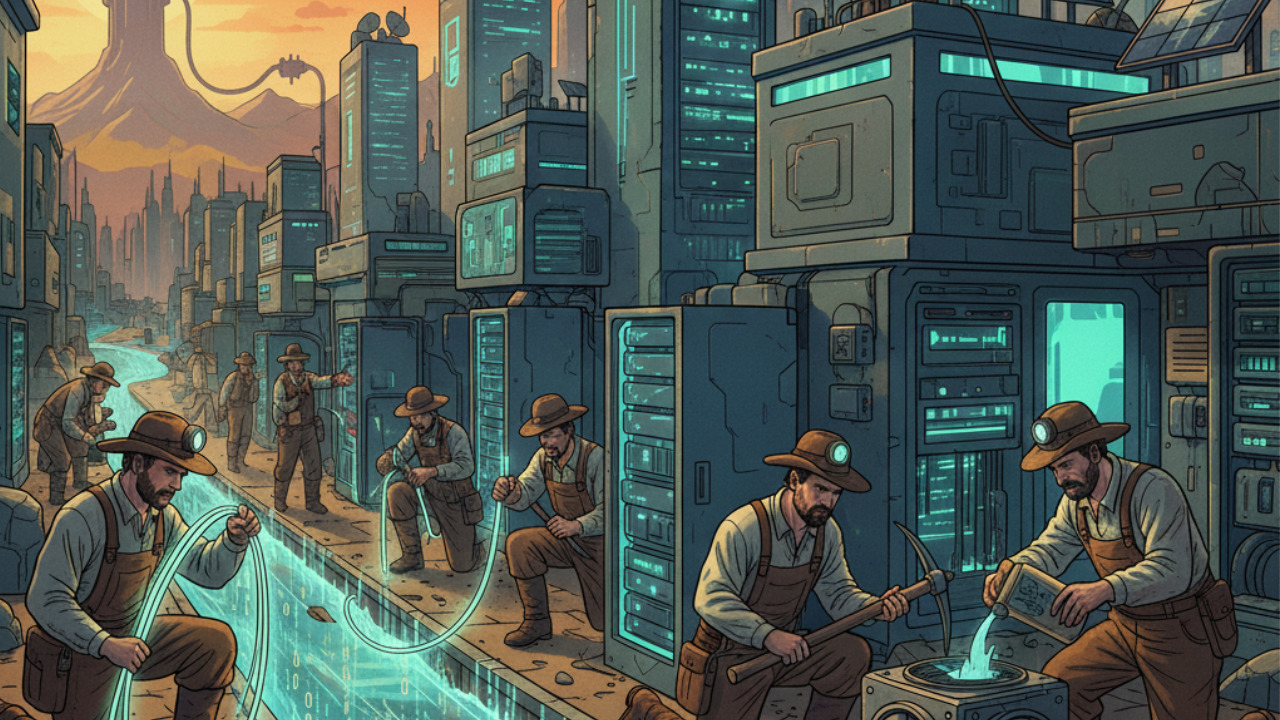
In the 1840s, thousands of hopefuls flocked to California with visions of gold nuggets the size of fists. Most died broke. But the people who sold them the copper-riveted denim, the sturdy shovels, and the overpriced flour? They didn't just survive; they built legacies that are still trading on the stock exchange today.
Fast forward to 2026, and we’re in the middle of a digital gold rush. Everyone is scrambling to build the next "ChatGPT killer." But if you’re looking at the landscape through the lens of a Product Manager; balancing the chaos of market trends against sustainable growth, the data suggests the shiny objects are a distraction.
The real play isn't building the AI products. It’s becoming an AI Enabler.
The 4-to-1 Reality Check
If you think the money is in the "ore" (the models), look at the history books. Between 1848 and 1855, miners pulled about $500 million in gold from the earth. Impressive, right? Except that in the same period, the international trade in supplies generated $2 billion.
For every £1 of gold found, £4 was made selling tools, food, and textiles. The "multiplier effect" proved that the infrastructure was four times more valuable than the prize itself.
While the "Bonanza Kings" of the 19th century eventually saw their mines run dry, the service companies stayed. Today, the combined market cap of survivors like Wells Fargo and Levi Strauss exceeds $324 billion, comfortably eclipsing the modern valuation of all the gold and silver pulled during the entire rush.
The detail: The Economics of the Rush
The Multiplier Effect: For every $1 of gold pulled from the earth, $4 was generated in the trade of supporting goods like tools, food, and textiles.
- Survival Rate: Most individual prospectors earned small or zero returns. In contrast, the merchants who provisioned them established some of the most enduring corporate legacies in American history, with several still trading today as multi-billion dollar enterprises.
- Total Mineral Wealth: The California Gold Rush (1848–1855) yielded gold valued at approximately $200 billion in modern prices, while the Comstock Lode silver rush (1859–1880) added another $17 billion to $35 billion.
Gold Mine Owners: Rags to Riches (and Back)
Most early mine owners were individuals or small partnerships that eventually gave way to industrial corporations as surface gold disappeared.
John Sutter (Sutter’s Mill): As the owner of the land where gold was discovered in 1848, he should have been the era's greatest beneficiary.
- Status: Out of Business. Sutter was bankrupted by 1852 as his workers deserted him and squatters destroyed his crops and cattle.
Empire Mine: One of California’s most successful hard-rock operations, yielding 5.8 million ounces of gold ($12 billion modern value).
- Status: Out of Business. It operated for 106 years before finally closing in 1956.
John Mackay (The Bonanza Kings): Hit the "Big Bonanza" strike in 1873, yielding $166 million in five years.
- Status: Merged/Evolved. Mackay used his wealth to found the Commercial Cable Company and the Bank of Nevada, laying the groundwork for the modern global data network.
George Hearst: Amassed a fortune of $19 million ($1.5 billion+ modern value) through quartz mining.
- Status: Evolved. His mining wealth funded the founding of the Hearst publishing empire, which remains a global media giant today.
John and Daniel Murphy: Extracted $2 million in gold ore in a single year, becoming millionaires before the age of 25.
- Status: Transitioned. They settled the town of Murphys, California, eventually transitioning into successful commercial and agricultural ventures.
Supporting Businesses: The 175-Year Success Stories
The "secondary" industries proved far more resilient, with many original Gold Rush providers evolving into modern giants.
Wells Fargo & Company (est. 1852): Founded to provide express delivery and banking for Gold Rush pioneers.
- Status: Still Trading. It is currently one of the largest financial institutions in the world. 2024 Revenue: $82.3 billion.
Levi Strauss & Company (est. 1853): Began by selling durable "waist-high overalls" (denim jeans) with copper-riveted reinforcements to miners.
- Status: Still Trading. It remains a global leader in apparel. 2024 Revenue: $6.36 billion.
Macy’s, Inc. (est. 1858): Rowland Hussey Macy’s first store for miners in Marysville failed in 1849. He successfully restarted in New York in 1858 using principles learned in California.
- Status: Still Trading. It is a cornerstone of American retail. Fiscal 2024/25 Revenue: $23.01 billion.
Ducommun Incorporated (est. 1849): Started as a hardware store and metal supplier in Los Angeles to serve mining and agricultural needs.
- Status: Still Trading. It has transitioned into a multinational aerospace engineering firm. 2024 Revenue: $786.55 million.
Brooks Brothers (est. 1818): Capitalised on the rush by outfitting gold-seekers with ready-made suits in the early 1850s.
- Status: Still Trading. Now owned by Authentic Brands Group (ABG), which generates $1.2 billion in annual royalty income from its portfolio.
Armour & Company (est. 1867): Founded by Philip Armour using $8,000 in seed money earned from constructing sluices for miners.
- Status: Still Trading (Brand split). The Armour brand is now split between Conagra Brands (2025 Revenue: $11.6 billion) and WH Group/Smithfield Foods (2024 Revenue: $25.94 billion).
Historical vs. Modern Wealth Comparison
While the total modern valuation of the gold and silver rushes is impressive at roughly $235 billion, the top four surviving "service" companies listed above (Wells Fargo, Levi’s, Macy’s, and Ducommun) hold a combined market capitalization of over $324 billion as of early 2026. This illustrates that the infrastructure built to support the rush ultimately became more valuable than the minerals themselves.
Servicing the Basilisk
Whether you view AI as a productivity tool or a looming "Roko’s Basilisk," the safest place to be is the person making sure the machine has a comfortable place to sit; and the right tools to work with. Infrastructure is the only "permanent and compounding foundation."
Being an AI enabler might mean pivoting your focus toward the "picks and shovels" of the 21st century:
- The Physical Layer: Data centres aren't self-cleaning. The hardware running these models is delicate, expensive, and runs incredibly hot. There is a fortune in specialised maintenance, liquid cooling, and clean-room services.
- The Digital Toolkit (API-First Services): AI models are "brains in a bucket", they can think, but they can't "act" without tools. The next billion-pound businesses will be the ones building the secure APIs, database connectors, and "action-layer" software that AI agents plug into to execute tasks in the real world.
- Workflow Integration: Businesses don’t just need AI; they need AI that doesn't break their legacy systems. Helping a law firm implement "agentic AI" to handle admin is far more valuable than selling them a generic chatbot subscription.
- The "Blue-Collar" Side of Tech: Someone has to build the warehouses, manage the massive energy grids, and run the fibre optics. This is unglamorous, high-margin work that the "AI Empires" cannot function without.
A Note on the "Software Shovel"
The second point is particularly interesting for us software folk. We are seeing a shift where "software for humans" is being overtaken by "software for agents." If you build a service that an AI agent must use to complete a high-value task (like a specialised payment gateway or a verified data retrieval tool), you’ve just built the 2026 version of a Levi’s rivet.
Chaos vs. Strategy
In my life as a PM, I’m constantly weighing the "new and shiny" against "what actually scales." It’s easy to get caught up in the hype of a new LLM release, but true stability comes from being the person the industry cannot sack.
The mining owners of the 1850s, like John Sutter, ended up bankrupt while squatters ruined their land. Meanwhile, the hardware and banking providers turned a fleeting boom into 175-year success stories.
Let the others fight over the nuggets. I’ll be over here sharpening the shovels.